Scientific Workshop and Experience SharingNatural Resources, Food Security and Inclusive Economy
A knowledge-sharing workshop on natural resources, food security and women’s financial autonomy. Discover the first results of the BNT project and present your own work.
FreeOnline attendanceWithout a presentation · See fees
Call for abstracts extended to 25 November 2026Rolling review · decision by 27 November at the latest
The workshop starts in
00days
00hours
00minutes
00seconds
01Why this workshop?
An issue at the crossroads of research, territories and sustainable development
In many regions of the world, particularly in sub-Saharan Africa, natural resources contribute to the livelihoods of rural populations. Among them, neglected and underutilised resources hold a potential that remains insufficiently explored for food security, income generation and the development of local economies.
The central question
Yet their valorisation raises a major challenge: how can their economic use be reconciled with the preservation of ecosystems and a lasting improvement in people’s living conditions?
CIGLRN 2026 aims to bring together researchers, practitioners, organisations and local authorities to compare scientific knowledge with field experience and identify sustainable, inclusive approaches to local management.
An issue shared by several fields of research
This issue draws on several fields of research, notably work on the governance of common-pool resources, social-ecological systems and sustainable livelihoods. These approaches highlight the importance of the interactions between people, institutions and ecosystems in natural resource management.
A fundamental tension
They also reveal a fundamental tension: while economic valorisation can strengthen communities’ interest in these resources and help improve their incomes, it can also increase pressure on ecosystems when harvesting is not governed by sustainable management practices.
Experiences that are still poorly documented
Despite the growing number of local valorisation initiatives, their results, the way they work and their effects on natural resources remain insufficiently documented, analysed and compared. This gap limits the spread of relevant experiences and our understanding of the conditions under which resource conservation, value creation and better living conditions can be reconciled over the long term.
The Crossroads, a space for dialogue
This is the context for the International Crossroads on Local Natural Resource Management (CIGLRN 2026), initiated by GREDD ONG. The meeting aims to provide a space for dialogue between researchers, academics, practitioners, development organisations and local authorities, in order to compare scientific knowledge with field experience, share the results of existing initiatives and identify the approaches and conditions that favour local management of natural resources that is sustainable, inclusive and economically viable.
Save the date3–4 December 2026 · In person and online
02The framework
Workshop objectives
Overall objective
To share and compare scientific knowledge and field experience on the local management of natural resources as a source of lasting income for women, girls and local people.
Specific objectives
01
Share experiences
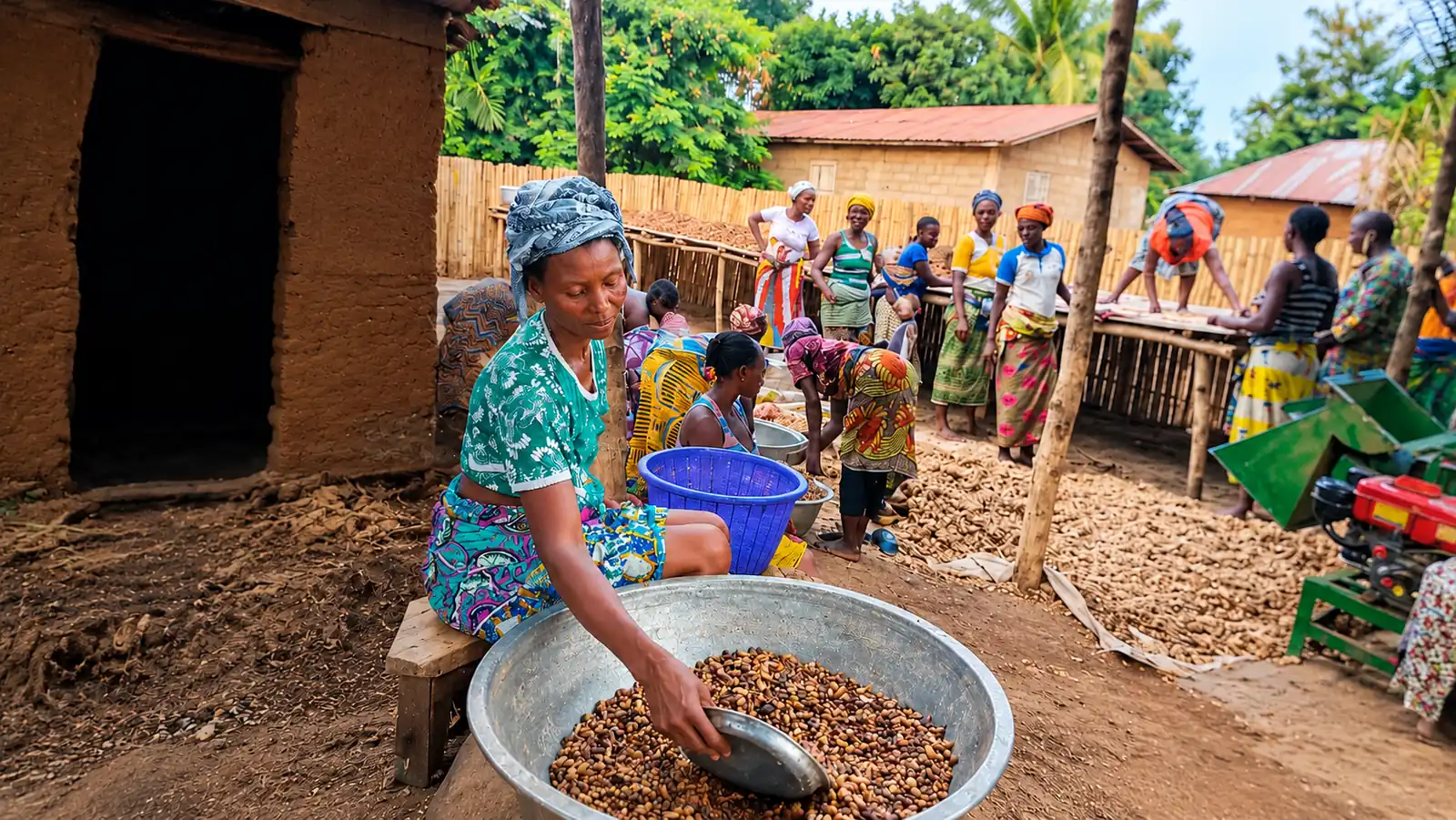
Share experiences of local natural resource management, including that of the BioNutriTech (BNT) project in Zogbodomey.
02
Bring actors into dialogue
Bring researchers, students, practitioners, NGOs and local authorities into dialogue around the five workshop themes.
03
Identify the levers
Identify the conditions for these initiatives to succeed and scale up.
Expected outcomes
By the end of the two days
Scientific papers
Scientific papers presented and discussed across the five themes.
Field experience
Experience from local actors shared and put into perspective.
Avenues for collaboration
Avenues for collaboration and scaling up identified during the round table and the closing synthesis.
Our impact in figures
1 150Direct beneficiaries, mostly women and girls.
7 500Indirect beneficiaries (approx.).
5Villages in the municipality of Zogbodomey.
10 haOf waterlogged land to reforest.
BioNutriTech (BNT) project · GREDD NGO
03Who is it for?
Who takes part
A meeting open to everyone working for the local management of natural resources.
Presentations and abstracts must fit one of these themes. The five themes follow the cycle of a resource: we add value to it, it feeds people, it gives rise to businesses, we process it, and then we restore the environment that produces it. At the centre, local management links every stage.
5 themes
20 suggested topics
2 languages: French, English
2 days of exchanges
Tap a theme to see its details.
Local management of natural resources
▦
05 Workshop · Official programme
Workshop Programme
Exchange · Share · Act for the sustainable use of our resources
Venue and how to attend
In person
Meeting room of the ATDA municipal unit, Pôle 5, Zogbodomey (Benin).
Choose how you will attend. You will receive the practical information by e-mail, including the connection link if you attend online. Presenting your work? Go to the “Submit an abstract” tab.
Dates: Thursday 3 and Friday 4 December 2026, 9:00 am to 5:30 pm.
Attendance: in person or online. The venue and how to connect are given in the programme.
Fees: online attendance without a presentation is free; in-person attendance and presenting a paper are charged according to your category. See fees.
Certificate: issued to participants who attend at least 80% of the workshop.
Attend the workshop online, without presenting a paper.
Charged according to your category, for:
attending in person;
presenting a paper, online or in person.
Student10,000 FCFAabout €15
Non-student or researcher20,000 FCFAabout €30
Institution or organisation30,000 FCFAabout €46
When to pay? Nothing to pay when you register or submit an abstract. The payment link is e-mailed once your abstract is accepted (presentation) or your registration is confirmed (in person).
A field organisation, international scientific networks and long-standing partners, brought together around local natural resource management.
Organiser
GREDD NGO
Research and Expertise Group for Sustainable Development, Abomey-Calavi (Benin). GREDD NGO designs and organises the CIGLRN 2026 Crossroads and hosts this edition in Zogbodomey.
AfriOCATAfrican network of the WOCAT community, committed to sustainable land and natural resource management in Africa.
International Association of Engineering Sciences for Peace (IAESP e.V.)Cooperation in Engineering Sciences, Research, the Environment, and Sustainable Development.
Bamboo Consulting for SustainabilitySustainability consulting firm.
Alkebulan Services et Conseils (ASC SARL)Works on issues related to the environment, climate change, natural resource management and territorial development.
Attending online without presenting a paper is free. In-person attendance and presenting a paper are charged: 10,000 to 30,000 FCFA depending on your category. See fees.
02When and how do I pay?
Nothing to pay when you register or submit an abstract. The payment link is e-mailed to you once your registration is confirmed (in person) or your abstract is accepted (presentation).
03In which language can I submit my abstract?
In English or French. The working languages of the workshop are French and English.
04How do I attend in person or online?
Choose your attendance mode in the registration form. The venue and how to connect online are given in the Programme section.
05Do I need to submit an abstract to take part?
No. You can simply register to attend. Abstracts are for those who wish to present their work.
06How will I receive the connection link?
By e-mail, at the address given in the registration form. Please check your spam folder.
07Who pays for accommodation and transport?
Accommodation and transport are at participants’ own expense.
08Can I get a certificate of attendance?
Yes, provided you attend at least 80% of the workshop, in person or online. Attendance is checked with a sign-in sheet and the online connection report.